When Your Partner Changes—and You Don’t Know How to Change With Them

People change. The person you fell in love with is not necessarily the same person you are living with 10, 20 or 30 years later.

And neither are you.

Sometimes that change is obvious. A partner changes careers, retires, becomes a parent, develops new interests, or goes through a major life experience.

When your partner changes, the relationship may need to change too. Discover why couples can struggle with change and how to reconnect with the person your partner is becoming.

But often the changes are much more subtle.

Your partner becomes more independent. They become quieter. They want to travel more. They become interested in health, spirituality, fitness or a completely different way of living. They may become more confident—or more anxious. Perhaps they no longer enjoy the activities you once shared.

And suddenly, you find yourself thinking:

“What happened to the person I married?”

We can become attached to who our partner used to be

One of the less obvious challenges in a long-term relationship is that we can carry an internal picture of our partner that was formed years ago.

We remember who they were when we met.

We know what they used to enjoy.

We know how they used to respond to us.

We may even expect them to continue playing the same role in our life.

The problem is that our partner may have moved on from that version of themselves.

Yet we may still be relating to the person we remember rather than the person who is standing in front of us today.

This can create a strange kind of disconnection.

Your partner may say, “You don’t understand me anymore.”

And you may genuinely think, “But I know you better than anyone!”

Both experiences can be true.

Change doesn’t necessarily mean something is wrong

When a partner changes, it can initially feel threatening.

You may wonder:

  • Why doesn’t my partner want to do the things we used to enjoy?
  • Why are they suddenly interested in something I’ve never cared about?
  • Why don’t they seem to need me in the same way?
  • Have we grown apart?
  • Does this mean they are unhappy with me?
  • What if they keep changing and I can’t keep up?

It’s understandable to interpret change as a threat to the relationship.

But change isn’t necessarily a sign that the relationship is failing.

Sometimes it is an invitation for the relationship to grow into its next stage.

The person you married may still be there—but with more layers

Long-term relationships have an extraordinary opportunity that newer relationships don’t have.

You get to know someone through different versions of themselves.

The energetic young adult.

The exhausted new parent.

The ambitious professional.

The empty-nester.

The person approaching retirement.

The person discovering new interests and priorities later in life.

Each stage can bring out qualities that weren’t visible before.

The challenge is allowing yourself to become curious about those qualities rather than resisting them.

Instead of thinking:

“You’re not the person I married.”

There can be another question:

“Who are you becoming?”

That question changes the conversation.

Sometimes the relationship needs to change too

If one person changes significantly, maintaining exactly the same relationship structure may no longer work.

Perhaps one partner wants more independence.

Perhaps the other wants more closeness.

Perhaps one wants adventure while the other wants security.

Perhaps one is ready to slow down while the other is discovering a new sense of purpose.

These differences don’t automatically mean that the couple is incompatible.

They may simply mean that the relationship needs renegotiating.

The routines, expectations and assumptions that worked ten years ago may not work today.

A healthy long-term relationship isn’t necessarily one that stays the same.

It is one that can adapt without losing connection.

Stay being curious about each other

One of the easiest things to lose in a long relationship is curiosity.

We think we already know our partner.

We know what they will say.

We know what they like.

We know how they think.

But people continue to evolve.

Try replacing assumptions with questions.

Instead of:

“You never want to do anything with me anymore.”

Try:

“I’ve noticed you’ve become much more interested in doing things independently. Can you help me understand what that means for you?”

Instead of:

“You’re not the same person anymore.”

Try:

“I feel as though you’re changing in some ways, and I’d really like to understand what’s important to you now.”

The difference may seem small, but curiosity creates an opportunity for connection rather than defensiveness.

And don’t forget that you have changed too

There is another side to this.

Sometimes we become frustrated because our partner has changed without noticing how much we have changed.

You may have different priorities now.

Different boundaries.

Different hopes for the future.

Different needs for affection, independence, companionship or adventure.

Perhaps the relationship isn’t simply about learning to accept your partner’s changes.

Perhaps both of you need to discover who you are now—and who you want to become together.

A relationship isn’t a museum

Long-term love doesn’t require preserving the relationship exactly as it was at the beginning.

You don’t have to recreate your first years together.

You don’t have to keep doing the same things simply because they once made you happy.

A relationship can have a history without being trapped by its history.

The person beside you today deserves to be known as they are today.

And so do you.

What if you feel that you’ve grown apart?

Growing in different directions can be painful, particularly when you remember how close you once felt.

But before assuming that the relationship is over, it can be worth asking:

Have we actually grown apart—or have we simply stopped getting to know each other?

Sometimes couples don’t need to return to who they were.

They need to discover who they can become together now.

That may require difficult conversations, greater empathy and a willingness to let go of some old expectations.

It can also create an entirely new chapter in the relationship.

Imago Relationship Therapy can help couples meet each other again

In Imago Relationship Therapy, couples are encouraged to move beyond the idea of simply changing their partner.

Instead, the focus is on developing a deeper understanding of each other’s inner world.

That can be particularly valuable when a long-term relationship has reached a point where both people have changed—but haven’t yet found a way to connect with those changes.

Sometimes the most important question isn’t:

“How do I get my partner to become the person I want them to be?”

It is:

“Can I become curious about the person my partner is becoming—and allow them to become curious about me?”

Because long-term love isn’t about remaining unchanged.

It’s about continuing to discover each other.


Caring4Couples and ImagoSydney offer Imago Relationship Therapy and couples counselling for partners who want to understand each other more deeply and create a stronger connection. Sessions are available in person and online.

Ready to Take the Next Step?

If you are ready to rebuild connection and navigate relationship challenges with practical support, appointments are available in-person or virtually for your convenience:

Make an Enquiry / Book an Appointment

About the Author

Christine Bennett is an experienced Relationship Therapist, Imago Relationship Therapist, Family Mediator, Counsellor, and Coach with over 20 years’ experience supporting individuals, couples, and families.

Through Caring4CouplesImago SydneyNorth Shore Family MediationCB-Counselling, and Psyche-Care, Christine provides compassionate, practical guidance to help clients improve communication, navigate complex disputes, build resilient connections, and foster deeper emotional well-being.
Please Share!

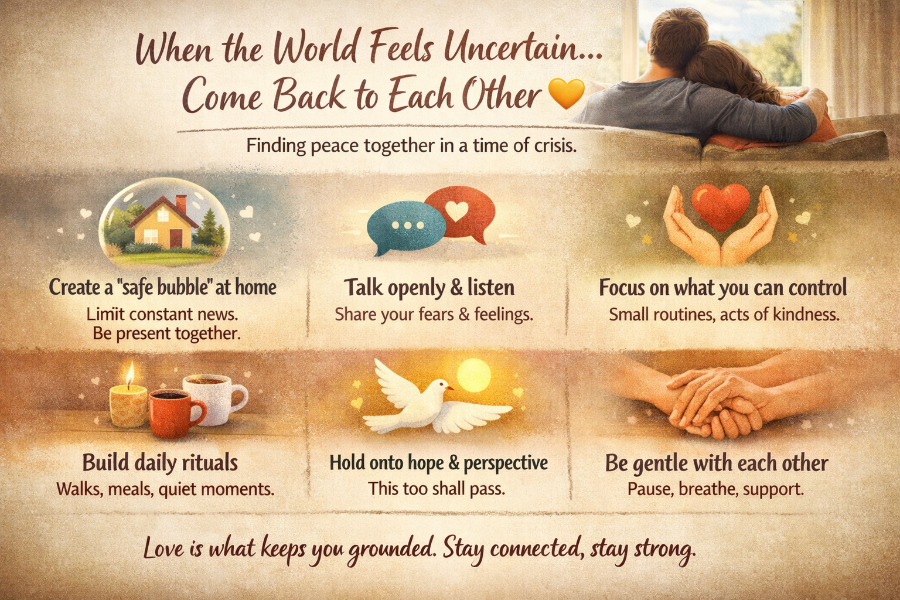
When the World Feels Uncertain… Come Back to Each Other

With everything happening globally right now — including the ongoing conflict in Iran — it’s natural to feel unsettled, anxious, or even overwhelmed. (Encyclopedia Britannica)

But in times like these, your relationship can become your greatest source of stability.

Here are a few gentle ways couples can stay grounded together:

Practical tips for couples coping with global uncertainty—stay connected, manage fear, and build resilience together during challenging times.

* Create a “safe bubble” at home
Limit constant news exposure. Stay informed, but not consumed. Choose specific times to check updates — not all day.

* Talk openly (without trying to fix everything)
You don’t need all the answers. Just listening to each other’s fears and thoughts builds emotional safety.

* Focus on what you can control
Your routines, your health, your kindness toward each other — these matter more than ever.

* Build small daily rituals
A walk, a shared meal, a cup of tea together. These moments anchor you when the outside world feels chaotic.

* Hold onto perspective and hope
History shows that even intense conflicts eventually move toward resolution. Right now is not forever.

* Be gentle — with yourself and each other
Stress can show up as irritability or withdrawal. Pause, breathe, and remember you’re on the same team.

In uncertain times, love isn’t just a feeling — it’s something you practice.

And sometimes, the most powerful thing you can do… is simply stay connected.

For your convenience, appointments are available as follows:

ERINA, CENTRAL COAST NSW
Location Information

CROWS NEST, SYDNEY NSW
Location Information

ONLINE – SECURE MEETING ROOM
More Information

Christine Bennett
 Imago Relationship Therapist
 Caring4Couples-Reconnecting Intimacy

#ImagoRelationshipTherapy #CouplesSupport #EmotionalWellbeing #Caring4Couples

Please Share!

Changing Beliefs With Brainwave Entrainment

What is Brainwave Entrainment?

Brainwave entrainment uses technology to assist the brain to access specific frequencies depending on what we would like to achieve.

In the normal waking state our brains usually operate at Beta frequency. When we are relaxed and during meditation, the brain enters Alpha frequency allowing us to feel calm and relaxed as acetylcholine is released.

If the brain operates for long periods in high Beta frequencies, agitation and anxiety may result from an excessive production of dopamine. Brainwave entrainment is a particularly useful way of rapidly altering the brainwave frequencies to assist in reducing anxiety or depression.

meditation-musicBrainwave States and Frequency Following Response

Using brainwave entrainment, access to particular brainwave states is possible where learning, belief changes and change of mood can take place in an extraordinary way.

There is a natural tendency of the brain to have a Frequency Following Response. The brain tends to tune in to the rhythms of what is around in the environment. For example, when the brain tunes in to catchy dance music, the body is usually inclined to move in sync with the music and mood is likely to improve accordingly.

So with brainwave entrainment, beats and frequencies are used to enable the brain to reach the preferred brainwave state for optimal learning or personal change. The neurons in the brain then start firing at specific frequencies. When this happens, neurochemicals and endorphins are released.

Brainwave Entrainment, Belief Changes and Emotional State Regulation

When brainwave entrainment is combined with affirmations, the affirmations are far more effective in reaching the subconscious mind where real change occurs. While operating in Theta frequency, the brain releases a hormone called LTP (Long Term Potentiation). Without this hormone, your affirmations may be heard, but they are not retained.

During childhood between the ages of 2 and 6 years, the brain operates mainly in Theta. This is why children are so susceptible to taking on beliefs as well as having an amazing capacity to learn.

Overcoming Anxiety and Depression

Brainwave entrainment has been shown to increase neural pathways. More are actually created. This is useful for creating new happiness pathways to overcome anxiety and depression as well as new learning and personal change. Brainwave entrainment is even more effective than hypnosis. Negative belief patterns and beliefs can be changed in a similar way to hypnotic induction, only at a much deeper level. This makes any type of personal change that much easier. By simply listening to brainwave technology with recorded affirmations on a digital music device (with headphones), significant change becomes readily achievable.

Christine Bennett

Please Share!

Reprogram your subconscious mind

It is difficult to ignore the increasing information being presented through scientific research about the brain and the mind. How our brain works and which part is responsible for different functions, is being reported on a daily basis. “Neuroplasticity” seems to be the new buzz word around scientific and therapeutic circles and Bruce Lipton PhD, stem cell biologist (best selling author of Biology of Belief), is busy spreading the word on the extraordinary power of our subconscious mind comparative to the measly 5% influence of our conscious mind.

Cells carry memories of our beliefs and can be reprogrammed.

Bruce Lipton’s research and information about how cells work and how the mind works, in addition to using techniques such as EFT (Emotional Freedom Techniques) hypnosis and Neuro-Linguistic-Programing with my clients, has led me to experiment with affirmations recorded with theta brain wave frequencies and a non-intrusive sound track.

So, if you were my client and wanted to change some aspect of your life, we would explore what beliefs you may be harboring in your subconscious that were sabotaging your conscious desires to change. And according to Bruce Lipton the subconscious is one million times more powerful than conscious will power – so there needs to be some heavy duty mechanism available to change long-held, firmly entrenched self limiting beliefs.

So in addition to techniques outlined above, I record a set of positive affirmations based on your own desires for change and give you your own unique set of affirmations to listen to on a daily basis through headphones while in a relaxed state. There is tons of research that shows that affirmations on their own do NOT work! This is because of the power differential of the subconscious saboteurs and conscious desires. I’ve already mentioned which side will win!

So the only way to win is to  access the subconscious mind and make changes where the limiting beliefs originated before the tender age of seven years. The language of the affirmations needs to be simple – keeping in mind that the original beliefs were formed when language skills were that of an infant.

The recorded affirmations need to be heard in a brain state that bypasses conscious objections and ridicule. This is why the theta brainwave is important. This is the brainwave state in which a pre-seven-year-old mostly experiences life and what survival mechanisms will ensure survival in their family. This is  mighty important stuff for the survival in the family of origin. However it rarely, if ever works in adult intimate relationships.

I found a podcast today where Bruce Lipton offers seven ways to reprogram the subconscious mind. I hope you find it interesting!

About the author:
Christine Bennett is a private practitioner committed to a non-judgmental approach of helping couples, individuals and families enjoy more fulfilling, loving relationships with themselves and others. Christine also helps separated couples reach agreements for parenting plans, financial settlements and bullying disputes.

Websites managed by Christine Bennett:
Caring4Couples | Christine Bennett Consulting | Psyche-Care |
North Shore Family Mediation | Stop the Bullying
© Christine Bennett

Please Share!

Change and reflections in Winter

Well, it seems my winter has taken a lot longer than the calendar would indicate for the changes and reflection that have taken place for me since my last blog entry.

Many changes have transpired in my life, in the lives of those close to me as well as the lives of clients. Some of those changes have been life affirming and some have involved significant loss through unexpected death.

All of those changes leave me with a strong conviction that we never know when our number might be up and it matters to make every day count. Some people have the idea that making every day count means being busy and crossing off every entry on an ongoing to-do list. For me, making every day count means tuning in to myself and assessing what the count might mean for that particular day.

Some days might be filled with appointments which means I need to be on the ball and well organized to meet both the client’s needs and my own for adequate rest and nourishment. Other days may be days at home where I could busy myself with chores or admin stuff, pull out weeds in the garden, or head for the beach with the grand-babies.

Gazing at the bright blue yonder.
Gazing into the bright blue yonder.

Sometimes, just doing nothing is what the body and mind needs for making the best of the day. Life can become a bit hectic and overwhelming and when it does, making the most of the day might be just sitting on the couch or out in the sun and dozing. Vitamin D from natural sunlight is one of THE best pick-me-ups that costs nothing and is only dependent on the weather and your capacity to take time out to enjoy!

About the author:
Christine Bennett is a private practitioner committed to a non-judgemental approach of helping couples, individuals and families enjoy more fulfilling, loving relationships with themselves and others. Christine also helps separated couples reach agreements for parenting plans, financial settlements and bullying disputes.

Websites managed by Christine Bennett:
Caring4Couples | Christine Bennett Consulting | Psyche-Care |
North Shore Family Mediation | Stop the Bullying

© Christine Bennett

Please Share!