Rebuilding Emotional Safety in Relationships After Conflict

Conflict is not the problem in most relationships. The real issue is what happens after conflict—whether partners can repair the rupture, feel heard again, and restore a sense of emotional safety. Without that repair, even small disagreements can start to feel threatening, and distance slowly replaces connection.

Couples counselling often focuses less on “who is right” and more on rebuilding emotional safety, because that is the foundation everything else depends on.

Learn how couples counselling can help rebuild emotional safety after conflict, improve communication, and restore trust in your relationship through practical therapeutic strategies.

What emotional safety actually means

Emotional safety is the sense that you can be open, vulnerable, and honest with your partner without fear of humiliation, rejection, retaliation, or emotional withdrawal.

In relationships with strong emotional safety, partners can:

  • Express feelings without being shut down
  • Disagree without fear of punishment or escalation
  • Admit mistakes without shame spirals
  • Ask for reassurance without being dismissed

When emotional safety is missing, couples often fall into protective patterns:

  • One partner withdraws to avoid conflict
  • The other escalates to be heard
  • Conversations become defensive rather than curious
  • Repair attempts are missed or misunderstood

Over time, this creates a cycle where both people feel alone, even when they are technically “talking.”

How conflict erodes emotional safety

Even loving relationships can lose emotional safety through repeated unresolved conflict. This doesn’t usually happen because of one big event, but through accumulation.

Common patterns include:

1. Unrepaired arguments
 
When arguments end without repair, resentment builds underneath the surface.

2. Defensive communication
 
Phrases like “you always” or “you never” shift the focus from understanding to blaming.

3. Emotional shutdown
 
One partner stops sharing because it “never goes well anyway.”

4. Escalation cycles
 
Small issues become intense because past hurt is still unaddressed.

Once these patterns become habitual, both partners often feel they must protect themselves rather than connect.

Why couples counselling focuses on safety first

A common misconception is that couples counselling is about teaching better communication skills straight away. In reality, most effective approaches start with stabilising emotional safety first.

Without safety:

  • Communication tools won’t stick
  • Active listening feels performative
  • “Rules” for arguing break down under stress

With safety:

  • Conversations slow down naturally
  • Partners become more curious instead of reactive
  • Repair happens more quickly after rupture

In other words, emotional safety is what makes everything else work.

Signs emotional safety needs rebuilding

You may benefit from focusing on emotional safety if:

  • Conversations regularly escalate into arguments or shutdowns
  • You feel “on edge” before bringing things up
  • One or both partners avoid difficult topics entirely
  • Apologies don’t lead to lasting change or relief
  • You feel lonely even when your partner is physically present

These signs don’t necessarily mean the relationship is failing. They often mean the relationship is stuck in protective patterns that can be changed with support.

What rebuilding emotional safety looks like in practice

In couples counselling, rebuilding emotional safety is not abstract—it involves very practical shifts in how partners interact.

1. Slowing down the interaction

When emotions are high, speed is the enemy of understanding. Couples are often guided to:

  • Pause before responding
  • Reflect what was heard before replying
  • Notice body language and tone, not just words

This reduces reactive cycles and creates space for clarity.

2. Learning repair after conflict

Repair is what restores safety after rupture. It may include:

  • Acknowledging impact (“I can see that hurt you”)
  • Taking responsibility without defensiveness
  • Clarifying intent without invalidating feelings
  • Reconnecting physically or emotionally after tension

Importantly, repair is not about erasing disagreement—it’s about restoring connection despite it.

3. Identifying underlying emotions

Many conflicts are not about the surface issue. For example:

  • Money arguments may mask fear of instability
  • Parenting disagreements may reflect feeling unsupported
  • Housework conflict may reflect feeling unvalued

Couples counselling helps translate criticism into underlying emotional needs, which are easier to respond to.

4. Rebuilding trust through consistency

Emotional safety is rebuilt through repeated experiences, not single conversations. That includes:

  • Following through on agreements
  • Showing responsiveness to emotional bids
  • Being consistent in tone and behaviour during stress

Trust grows when partners experience reliability over time.

5. Creating “safe structure” for difficult conversations

Many couples benefit from structured ways to talk, such as:

  • Time-limited check-ins
  • One person speaking at a time
  • Rules against interruption or escalation
  • Ending conversations with a brief repair moment

Structure reduces uncertainty, which lowers emotional threat.

What changes when emotional safety returns

When emotional safety is rebuilt, couples often notice:

  • Fewer arguments escalating out of control
  • Faster recovery after disagreements
  • More willingness to be honest earlier
  • Increased affection and spontaneity
  • Less need to “protect” oneself emotionally

Importantly, the goal is not a conflict-free relationship. Healthy couples still disagree. The difference is that disagreement no longer feels like danger.

A realistic expectation of progress

Rebuilding emotional safety takes time because it involves changing nervous system responses, not just communication habits. Early improvements may feel subtle:

  • Conversations feel slightly less tense
  • One partner opens up a little more
  • Recovery after conflict becomes faster

These small shifts are meaningful. Over time, they accumulate into a very different relational experience.

Final thoughts

Couples counselling is most effective when it focuses first on couples counselling emotional safety, because safety is what allows honesty, repair, and connection to exist without fear.

When partners feel emotionally safe, they stop managing each other as threats and start relating as allies again—even during disagreement. That shift is often the foundation for lasting change in a relationship.

For your convenience, appointments are available in the following locations:

ERINA, CENTRAL COAST NSW
Location Information

CROWS NEST, SYDNEY NSW
Location Information

ONLINE – SECURE MEETING ROOM
More Information

MAKE AN ENQUIRY


Christine Bennett
Imago Relationship Therapist
Caring4Couples – Reconnecting Intimacy and Connection


#ImagoRelationshipTherapy
#CouplesCounselling
#CouplesCounsellingCentralCoast
#CouplesCounsellingCrowsNest
#OnlineCouplesCounselling

Please Share!

Easter, Family, and the Relationship You Don’t Want to Neglect

Easter has a certain feeling about it.

It’s softer than Christmas. Less pressured. A little more spacious.

There are chocolate eggs, slower mornings, maybe a long weekend together. For many families, it’s one of the rare moments in the year where life pauses just enough to breathe.

And yet… for couples with children, Easter can quietly highlight something else.

The relationship that’s been sitting in the background.

Feeling disconnected after the holidays? Easter can highlight relationship stress for couples with children. Discover how to reconnect and when to seek couples counselling in North Sydney.

When Family Time Isn’t Couple Time

You might spend the long weekend:

  • Organising egg hunts
  • Managing sugar highs (and crashes)
  • Navigating extended family visits
  • Trying to keep everyone happy

By the end of it, you’ve “spent time together” as a family…

…but not really as a couple.

And that distinction matters more than most people realise.

Because relationships don’t drift apart in dramatic moments.

They drift in the small, everyday absences.

The Subtle Drift

You might notice it in ways like:

  • Conversations that stay practical (“Did you get the groceries?”)
  • Less physical affection
  • Feeling like housemates or co-parents rather than partners
  • Small irritations that seem to grow faster than patience

Easter can amplify this—not because anything is wrong—but because there’s finally space to feel what’s been there all along.

The Opportunity Hidden in Easter

Traditionally, Easter is about renewal. Reflection. Starting again.

And that’s not just symbolic.

It’s actually a perfect time to reset your relationship in small, meaningful ways.

Not grand gestures.

Just intentional ones.

A Few Simple Shifts This Easter

1. Create a “couple moment” (even 20 minutes)
 
After the kids are in bed, sit together without phones, TV, or distractions.

Not to solve problems.

Just to reconnect.

2. Ask a different question
 
Instead of “How was your day?” try:

  • “What’s been on your mind lately?”
  • “What do you need more of right now?”

You might be surprised by the answer.

3. Notice what’s working
 
It’s easy to focus on what’s missing.

But relationships grow stronger when we name what’s already good.

Even something as simple as:

“I really appreciated how you handled the kids today.”

4. Let go of one expectation
 
Not everything has to be perfect.

Sometimes the most loving thing you can do—for your partner and yourself—is to ease the pressure.

When It Feels Like More Than Just a Busy Season

For some couples, Easter doesn’t just highlight distance—it brings up deeper concerns:

  • Repeated arguments
  • Feeling unheard or unseen
  • Emotional disconnection
  • Questioning where the relationship is heading

If that’s you, you’re not alone.

And more importantly—it’s not something you have to figure out by yourselves.

A Gentle Invitation

At Caring4Couples, I often meet people at this exact point.

Not in crisis.

But in that quiet space of:

“Something feels off… and we don’t want it to get worse.”

That’s actually the best time to seek support.

Because small shifts now can prevent much bigger pain later.

This Easter, Consider This

Among the chocolate eggs, family time, and long weekend…

Take a moment to ask:

How is our relationship, really?

And if the answer feels uncertain, that’s not a failure.

It’s simply an invitation.

To reconnect.
  To understand each other again.
  To build something stronger—together.

For your convenience, appointments are available as follows:

ERINA, CENTRAL COAST NSW
 Location Information

CROWS NEST, SYDNEY NSW
 Location Information

ONLINE – SECURE MEETING ROOM
 More Information

Christine Bennett
Imago Relationship Therapist
Caring4Couples-Reconnecting Intimacy

#ImagoRelationshipTherapy #Caring4Couples #CouplesCounsellingErina
#CouplesCounsellingCrows Nest #CouplesCounsellingOnline

Please Share!

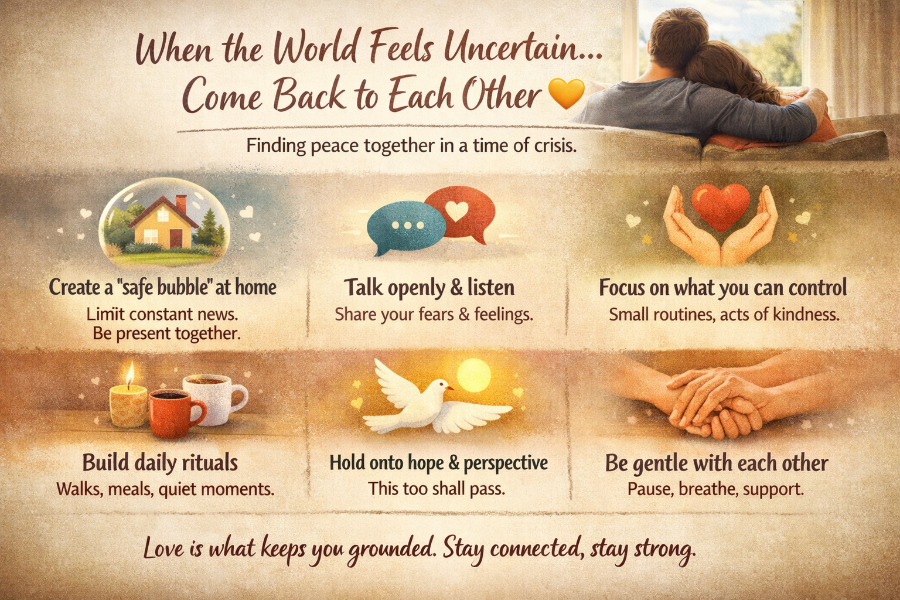
When the World Feels Uncertain… Come Back to Each Other

With everything happening globally right now — including the ongoing conflict in Iran — it’s natural to feel unsettled, anxious, or even overwhelmed. (Encyclopedia Britannica)

But in times like these, your relationship can become your greatest source of stability.

Here are a few gentle ways couples can stay grounded together:

Practical tips for couples coping with global uncertainty—stay connected, manage fear, and build resilience together during challenging times.

* Create a “safe bubble” at home
Limit constant news exposure. Stay informed, but not consumed. Choose specific times to check updates — not all day.

* Talk openly (without trying to fix everything)
You don’t need all the answers. Just listening to each other’s fears and thoughts builds emotional safety.

* Focus on what you can control
Your routines, your health, your kindness toward each other — these matter more than ever.

* Build small daily rituals
A walk, a shared meal, a cup of tea together. These moments anchor you when the outside world feels chaotic.

* Hold onto perspective and hope
History shows that even intense conflicts eventually move toward resolution. Right now is not forever.

* Be gentle — with yourself and each other
Stress can show up as irritability or withdrawal. Pause, breathe, and remember you’re on the same team.

In uncertain times, love isn’t just a feeling — it’s something you practice.

And sometimes, the most powerful thing you can do… is simply stay connected.

For your convenience, appointments are available as follows:

ERINA, CENTRAL COAST NSW
Location Information

CROWS NEST, SYDNEY NSW
Location Information

ONLINE – SECURE MEETING ROOM
More Information

Christine Bennett
 Imago Relationship Therapist
 Caring4Couples-Reconnecting Intimacy

#ImagoRelationshipTherapy #CouplesSupport #EmotionalWellbeing #Caring4Couples

Please Share!

How Global Events Like the Iran War Can Increase Stress for Couples

Recent global tensions involving Iran have been widely reported in the news, and many people are becoming concerned about the potential economic consequences. Rising fuel prices, supply disruptions and the possibility of higher food costs are creating uncertainty for households across Australia.

While these events may seem far away geographically, global conflicts can still affect everyday life — and sometimes they place unexpected strain on relationships.

Rising global tensions and cost-of-living pressures can strain relationships. Learn how couples can manage stress and stay connected.

Why global events can affect relationships

When international conflict disrupts oil supply or shipping routes, it can lead to rising fuel prices and increased costs for transporting goods. Economists warn that disruptions linked to the current conflict could push petrol prices higher and increase the cost of food and everyday items.

For many couples, financial pressure is one of the most significant sources of relationship stress. When household budgets tighten, partners may feel anxious about the future, frustrated with rising expenses, or worried about providing for their family.

Even small financial worries can trigger arguments or misunderstandings if both partners are already feeling overwhelmed.

Stress can show up in unexpected ways

When couples are under stress, the tension often shows up indirectly. One partner may become withdrawn or quiet, while the other may become more critical or reactive. These patterns are common when people feel uncertain about the future.

Concerns about fuel shortages, food costs or the cost of living can create:

  • More frequent arguments about money
  • Increased anxiety or irritability
  • Difficulty communicating calmly
  • Different views about saving or spending
  • A sense of emotional distance

Often the real issue isn’t the money itself, but the stress and uncertainty surrounding it.

The cost-of-living pressure many couples are feeling

Australia has already experienced rising living costs in recent years. Global disruptions to energy supplies can add another layer of pressure. Some economists have warned that oil supply disruptions could significantly increase global fuel prices and contribute to inflation.

When couples are already juggling mortgages, rent, groceries and childcare costs, even a small increase in fuel or food prices can make things feel overwhelming.

This can create a cycle where stress leads to conflict, and conflict increases stress even further.

How couples can support each other during uncertain times

During periods of uncertainty, relationships often benefit from slowing down and reconnecting rather than reacting.

A few helpful approaches include:

Talk openly about concerns
Instead of bottling up worries about money or the future, sharing concerns calmly can reduce misunderstandings.

Focus on teamwork
Remind yourselves that you’re facing challenges together, not against each other.

Avoid blame during stressful moments
Financial pressure can easily turn into blame, even when neither partner is responsible for the situation.

Make practical plans together
Sometimes simply making a budget or discussing priorities can reduce anxiety.

When outside support can help

If stress is beginning to affect communication or connection in a relationship, speaking with a counsellor can help couples step out of reactive patterns and reconnect.

Relationship counselling provides a neutral space where both partners can feel heard and supported while learning practical tools to improve communication and reduce conflict.

If you and your partner are feeling the strain of financial pressure, uncertainty or ongoing conflict, counselling can help you move from frustration toward understanding and connection.

For your convenience, appointments are available as follows:

ERINA, CENTRAL COAST NSW
Location information

CROWS NEST, SYDNEY NSW
Location information

NORTH WYONG, CENTRAL COAST NSW
Location information

#RelationshipStress #CostOfLiving #RelationshipCounselling #LoveAndConnection #CouplesCounselling #Caring4Couples #ImagoRelationshipTherapy #MarriageCounselling

Christine Bennett
 Imago Relationship Therapist
 Caring4Couples-Reconnecting Intimacy

Please Share!

The “Always On” Trap: Finding Real Connection in a Digital World

In 2026, we are more “connected” than ever, yet many couples feel like they’re living on separate islands. Between remote work blurring the lines of home life, the constant hum of notifications, and the “comparison trap” of social media, intimacy often takes a backseat to efficiency.

At Caring4Couples, we’re seeing a shift. The primary challenge for modern partners isn’t just “communication”—it’s presence.

Is your phone coming between you and your partner? Discover 3 simple ways to reconnect and prioritize your relationship in a digital world with Caring4Couples.

Why “Quality Time” Needs an Upgrade

We used to think quality time meant a weekly dinner date. Today, that’s not enough if you’re both checking emails between courses. True connection now requires Digital Boundaries.

  • The “Micro-Rejection”: When your partner starts a conversation and you glance at a vibrating phone, it sends a subtle signal: This device is more important than you. Over time, these micro-rejections build a wall of resentment.
  • The Comparison Hangover: It’s easy to feel your relationship is “failing” when you’re bombarded with curated highlights of other couples’ vacations and milestones.

3 Ways to Reconnect This Week

You don’t need a total lifestyle overhaul to see a difference. Small, intentional pivots can shift the entire energy of your home:

  1. The 10-Minute Tech Blackout: Establish a “phone-free zone” during the first 10 minutes after you both finish work. No scrolling, no checking Slack—just eye contact and a genuine “How are you feeling?”
  2. Shared Boredom: It sounds counterintuitive, but some of the best intimacy happens in the quiet moments. Try a “low-dopamine” evening: a walk, a puzzle, or simply sitting together without a screen as a buffer.
  3. Active Appreciation: In a fast-paced world, we tend to focus on what our partner isn’t doing. Flip the script. Once a day, call out something specific you appreciate, no matter how small.

You Don’t Have to Navigate This Alone

Every relationship hits a plateau where the old tools just don’t work anymore. Whether you’re navigating the complexities of a “dual-career” household, parenting in the digital age, or simply feeling the spark fade, therapy isn’t just for “fixing” things—it’s for optimizing your bond.

“The greatest gift you can give your partner is your undivided attention.”

At Caring4Couples, we provide a safe, modern space to help you rediscover the person sitting right across from you.

For your convenience, appointments are available as follows:

ERINA, CENTRAL COAST NSW
Location information

CROWS NEST, SYDNEY NSW
Location information

NORTH WYONG, CENTRAL COAST NSW
Location information

#CoupleGoals #RelationshipAdvice #ModernLove #RelationshipTips #LoveAndConnection #DateNightIdeas #Caring4Couples #ImagoRelationshipTherapy #CouplesCounseling

Christine Bennett
 Imago Relationship Therapist
 Caring4Couples-Reconnecting Intimacy

Please Share!

Why Couples Are Arguing More in 2026 – And How to Reconnect

If it feels like couples are carrying more tension lately, you’re not imagining it.

In 2026, many relationships are under pressure from constant connectivity, financial uncertainty, AI-driven workplace change, and the mental load of simply “keeping up.” Even strong couples are noticing shorter tempers, less patience, and more misunderstandings.

The good news? Conflict isn’t the problem. Disconnection is.

Let’s explore what’s happening — and what helps.


In 2026, many relationships are under pressure from constant connectivity, financial uncertainty, AI-driven workplace change, and the mental load of simply “keeping up.” Even strong couples are noticing shorter tempers, less patience, and more misunderstandings.

The New Stressors Affecting Couples

1. Digital Saturation (Even When You’re in the Same Room)

Phones are no longer just devices — they are workplaces, news feeds, entertainment hubs, and social spaces. Couples often sit beside each other physically while being mentally elsewhere.

Micro-disconnections add up:

  • Half-listening while scrolling
  • Checking emails during dinner
  • Watching separate reels in bed
  • Interrupting connection for notifications

Over time, partners may feel unseen or less important than a screen.


2. Financial Anxiety & Economic Shifts

Across Australia, many couples are navigating:

  • Rising living costs
  • Housing stress
  • Career instability
  • Changing work models (hybrid, remote, AI-supported roles)

Even if finances are stable, uncertainty alone can increase baseline stress — and stress reduces emotional bandwidth.

When we’re anxious, we become reactive.


3. The Invisible Mental Load

Modern couples are often committed to equality — but many still struggle with the invisible labour of planning, remembering, organising, and emotional caretaking.

Common patterns include:

  • One partner feeling overwhelmed but not asking for help
  • The other partner feeling criticised and unsure what’s wrong
  • Escalation over “small” issues that are actually about feeling unsupported

It’s rarely about the dishwasher. It’s about feeling alone in the responsibility.


The Real Issue: Emotional Safety

Research from relationship science (including the work of Dr John Gottman at The Gottman Institute) consistently shows that stable couples aren’t those who avoid conflict — they are those who repair quickly and maintain emotional safety.

Emotional safety means:

  • I can express frustration without being attacked.
  • I can be vulnerable without being dismissed.
  • We can disagree without threatening the relationship.

Without safety, partners shift into defence mode:

  • Criticism
  • Stonewalling
  • Sarcasm
  • Withdrawal

These aren’t signs of bad people. They’re signs of nervous systems under strain.


Three Practical Ways to Reconnect This Week

1. The 10-Minute Daily Reset

Set a timer for 10 minutes each evening.
Turn phones off. Refrain from problem solving and day-to-day issues.

Each partner answers:

  • What was one stressor today?
  • What did I need emotionally?
  • One thing I appreciated about you.

This builds connection without pressure.


2. Clarify the Mental Load

Instead of arguing about tasks, try this:

List everything required to keep your household and relationship functioning — appointments, bills, emotional check-ins, planning, social events.

Then ask:

  • Who is holding this mentally?
  • Is that working for both of us?

Awareness reduces resentment.


3. Slow the Conflict Down

When you notice escalation:

  • Lower your voice.
  • Pause for 20 minutes if needed.
  • Return with curiosity instead of argument.

Try:
“I think we’re both overwhelmed. Can we reset?”

Repair attempts matter more than being right.


A Gentle Truth

Every couple I meet wants the same thing: to feel chosen, valued, and safe.

Disconnection often happens gradually. So does reconnection.

If 2026 has brought more tension into your relationship, it doesn’t mean you are failing. It may simply mean you are navigating modern stress without enough support.

With intentional conversation, clearer boundaries around digital life, and space to understand each other’s inner world, couples can move from reactivity back to partnership.


If you’re feeling stuck in repetitive conflict or emotional distance, support can help you shift the pattern — not just manage the arguments.

For your convenience, appointments are available as follows:

ERINA, CENTRAL COAST NSW
Location information

CROWS NEST, SYDNEY NSW
Location information

NORTH WYONG, CENTRAL COAST NSW
Location information

#CoupleGoals #RelationshipAdvice #ModernLove #RelationshipTips #LoveAndConnection #DateNightIdeas #Caring4Couples #ImagoRelationshipTherapy #CouplesCounselling

Christine Bennett
 Imago Relationship Therapist
 Caring4Couples-Reconnecting Intimacy

Please Share!

Planning for Connection: Nurturing Your Relationship in the Modern World

In the whirlwind of modern life, where calendars are crammed and digital distractions abound, it’s easy for couples to feel a disconnect, even when sharing the same space. The demands of careers, family, and personal pursuits can leave little room for intentional connection, leading to a sense of drifting apart.

But what if we approached our relationships with the same foresight and planning we apply to our finances or careers? Just as a garden needs consistent care to flourish, so too does a partnership. For today’s couples, cultivating a strong and lasting bond requires proactive effort. It’s about creating dedicated spaces and times where you can truly see, hear, and appreciate each other.

1. Schedule “Us” Time (and Protect It!)

In our busy lives, if it’s not on the calendar, it often doesn’t happen. Treat your relationship time with the same importance as a professional commitment.

  • Date Nights: Whether it’s a fancy dinner out or a cozy movie night in, schedule regular date nights. Alternate who plans it to keep things fresh.
  • Micro-Moments: Don’t underestimate the power of small, consistent connections—a 15-minute coffee chat in the morning or putting phones away before bed.
  • Weekend Rituals: Establish a fun weekend ritual, like a Sunday morning hike or visiting a local market together.

2. Communicate with Intention

Effective communication is more than just talking; it’s about truly listening and understanding.

  • Regular Check-ins: Schedule dedicated times to “check in.” Discuss how you’re feeling, challenges you’re facing, or successes you’re celebrating.
  • Active Listening: When your partner is speaking, put away distractions. Make eye contact and listen to understand rather than just to respond.
  • Future Planning: Discuss your shared goals—from travel dreams to financial objectives. Aligning on these visions creates a powerful sense of shared purpose.

3. Create “Connection Rituals”

Planning isn’t just about logistics; it’s about creating a culture of appreciation. Rituals are the “glue” for your relationship.

  • The 20-Second Hug: Research suggests a 20-second hug releases oxytocin. Make it a ritual to hug when you first see each other after a long day.
  • The “High-Low” Dinner: Share the best part of your day (the high) and the most challenging part (the low) to stay updated on each other’s internal worlds.
  • A “Relationship Bucket List”: Once a quarter, plan one new thing to try together—a cooking class, a new hiking trail, or a weekend getaway.

A Personal Note

In my years working with couples across Sydney and the Central Coast, I’ve seen one consistent truth: The strongest relationships aren’t the ones without challenges; they are the ones where both partners decide to be “co-architects” of their shared life.

Planning for connection isn’t about adding another chore to your to-do list. It’s about creating a “safe harbour” where you can both exhale. Whether it’s that morning walk with the dog or a deeper conversation over coffee, these moments are the insurance policy for your relationship’s future.

If you find that the “plan” feels out of reach, or if the disconnect feels too wide to bridge alone, remember that reaching out for support is a sign of strength, not a failure of your partnership.

Let’s build that connection together.

Ready to move from “co-existing” to “truly connecting”? I offer a non-judgemental space to help you and your partner navigate the complexities of modern love.

For your convenience, appointments are available as follows:

ERINA, CENTRAL COAST NSW
Location information

CROWS NEST, SYDNEY NSW
Location information

NORTH WYONG, CENTRAL COAST NSW
Location information

#CoupleGoals #RelationshipAdvice #ModernLove #RelationshipTips #LoveAndConnection #DateNightIdeas #Caring4Couples #ImagoRelationshipTherapy #CouplesCounseling

Christine Bennett
 Imago Relationship Therapist
 Caring4Couples-Reconnecting Intimacy

Please Share!

What Couples Are Navigating in 2026: Real Issues, Real Talk

Relationships have always been a mix of joy and challenge, but the landscape in 2026 brings new stressors and fresh opportunities for connection. Whether you’ve been together for years or just started dating, the world we live in is shaping how we love, communicate, and plan for the future.

1. Navigating Digital Life Together

Technology is now the backdrop of nearly every relationship.

  • Social media pressure: Curated highlights vs. real life can create comparison anxiety — especially around milestones like anniversaries, vacations, or home ownership.
  • Boundaries with screens: Couples are learning that it’s not just about how much time you spend on your phone, but when. Meal times, bedtime scrolling, and morning routines are all common battlegrounds.
  • Dating apps after commitment: Some partners still use apps “for fun” or networking — and that can spark insecurity if boundaries aren’t clear.

Tip: Set tech norms early — e.g., phone-free dinners, agreed boundaries for social platforms, and transparency instead of secrecy.


Relationships have always been a mix of joy and challenge, but the landscape in 2026 brings new stressors and fresh opportunities for connection.
Couples Counselling North Wyong, Erina and Crows Nest.

2. Money Talks That Matter

Finances remain a top stressor for couples — but the conversation is evolving.

  • Cost of living pressures: With inflation and housing costs high in many parts of the world, priorities like saving vs. spending can cause tension.
  • Financial transparency: Hidden accounts or undisclosed spending erode trust fast.
  • Shared vs. separate finances: Many couples are rejecting the old “yours/mine/ours” model and creating hybrid approaches that respect individuality and shared goals.

Tip: Schedule quarterly money check-ins — not to police each other, but to align goals like travel, home upgrades, or retirement planning.


3. Mental Health as Relationship Health

Post-pandemic awareness of mental health is now a core part of healthy partnerships.

  • Normalize support: Encouraging therapy — individually and as a couple — is no longer taboo.
  • Stress spillover: Career stress, burnout, and anxiety can show up in how partners communicate or withdraw.
  • Empathy over judgment: Recognizing emotional needs as valid — even when they differ — builds resilience.

Tip: Practice “check-in conversations” — brief, scheduled moments to share how you’re actually feeling, no problem-solving required.


4. Evolving Gender Roles and Expectations

Traditional roles are shifting — and that’s exciting and confusing for some.

  • Household labor negotiation: Couples are rebalancing chores not by gender but by energy, schedules, and strengths.
  • Career ambitions: Supporting each other through job changes, relocations, or education can be both a bonding experience and a stressor.
  • Parental roles: Co-parenting norms are breaking old molds, and communication about expectations is essential.

Tip: Revisit roles every few months — what worked last quarter might feel outdated now.


5. Intimacy Beyond the Bedroom

Sexual connection matters, but so does everyday intimacy — the tiny moments of closeness that add up.

  • Physical affection vs. sex frequency: They’re not always synonymous. Holding hands or sharing a look can matter just as much as sex.
  • Desire discrepancies: It’s normal for libido to fluctuate, but avoiding the topic creates distance.
  • Emotional intimacy: Trust, vulnerability, and shared experiences fuel a deeper bond.

Tip: Ask questions like “What made you feel loved this week?” instead of benchmarking against past patterns or others’ relationships.


6. Planning for the Future — Together

Couples often struggle not with whether to plan, but how.

  • Big decisions loom: Marriage, kids, relocation, career pivots — each brings excitement and fear.
  • Goal alignment: It’s healthy to have different dreams — but sharing them openly avoids assumptions.
  • Flexibility is key: Life rarely goes according to plan, and adaptability strengthens teams.

Tip: Create a shared vision board or document — it can be lighthearted and aspirational rather than rigid.


Final Thought

Love isn’t static — it evolves with the world and with us. In 2026, healthy relationships are less about perfection and more about awareness, communication, and mutual growth.

Couples who thrive aren’t conflict-free — they’re curious, compassionate, and committed to becoming better partners every day.

For your convenience, appointments are available as follows:

ERINA, CENTRAL COAST NSW
Location information

CROWS NEST, SYDNEY NSW
Location information

NORTH WYONG, CENTRAL COAST NSW
Location information

#RelationshipAdvice #CouplesGoals #RelationshipReset #FreshStart2026

Christine Bennett
 Imago Relationship Therapist
 Caring4Couples-Reconnecting Intimacy

Please Share!

How to Stay Connected over Christmas

Christmas is fast approaching! The countdown is on and for many couples, Christmas can be a mix of celebration, pressure, and exhaustion. This time of year promises joy—family gatherings, familiar traditions, time off work—but the reality often includes financial strain, family tension, travel logistics, high expectations, disrupted routines, and emotional overload.

Even strong, loving couples may find themselves more irritable, disconnected, or overwhelmed during December. The good news? With a little awareness and planning, couples can turn Christmas stress into an opportunity to strengthen—not strain—the relationship.

How to stay connected over Christmas - Couples Counselling Crows Nest and Erina NSW

Here are the issues couples most commonly face this time of year, and what can help prevent holiday stress from becoming holiday conflict.

1. Emotional Overload & Exhaustion

People are tired by the end of a year. Work deadlines, school functions, social events, and Christmas planning create mental load—usually carried unevenly. One partner might feel responsible for gifts, food, family arrangements, or decorating, while the other doesn’t realise just how much is being done behind the scenes.

# Stress Prevention Tip:
Have a “holiday responsibilities” conversation. Sit down with a cup of tea and list what needs doing. Instead of one person silently carrying the load, divide tasks in a way that feels fair. Sometimes the healthiest choice is to simplify: fewer events, fewer expectations, more rest.

2. Money & Gift Pressure

Christmas is expensive. Gifts, food, travel, social outings, and family commitments can lead to financial stress—and financial stress is one of the biggest triggers for arguments.

# Stress Prevention Tip:
Agree on a spending plan before December hits. Find a number both of you feel comfortable with. Many couples feel relieved when they realise they can prioritise meaning over money: handmade, practical, or experience-based gifts can be more heartfelt and less stressful than expensive ones.

3. Family Tension

Visiting relatives—or hosting them—can bring up old patterns, unresolved issues, or emotional triggers. Couples may feel pressure to “keep the peace,” especially if one partner’s family is more dominant, critical, or demanding.

# Stress Prevention Tip:
Talk privately beforehand about boundaries:

  • How long to stay
  • When to leave
  • What behaviour is (and isn’t) acceptable
  • How you’ll support each other if tension rises

Sometimes the healthiest choice is shorter visits, separate events, or celebrating differently this year.

4. Different Expectations About Christmas

One partner may love big gatherings, decorations, and tradition. The other might long for quiet, rest, and a simpler season. Neither is wrong—but without communication, hurt feelings build quickly.

# Stress Prevention Tip:
Ask each other:

  • “What matters most to you about Christmas?”
  • “What would make this season enjoyable, not stressful?”
  • “Is there anything you’d like less of this year?”

Often, just being heard brings relief. You can create a version of Christmas that works for both of you—not what everyone else expects.

5. Lack of Couple Time

Busy schedules mean couples stop connecting. There’s plenty of doing, but not much being together. This makes people more reactive and less patient.

# Stress Prevention Tip:
Schedule small moments of calm:

  • A walk after dinner
  • Watching a holiday movie together
  • Saying no to one event to have a quiet night in
  • A slow morning coffee with no phones

Protecting connection is more important than having a picture-perfect holiday.

6. Loss, Loneliness, & Grief

Christmas can highlight who’s missing or which relationships have changed. Many people carry sadness alongside celebration. If one partner is grieving and the other is in “festive mode,” misunderstanding can arise.

# Stress Prevention Tip:
Name the feelings. Offer space for emotions. It’s possible to honour grief and still experience joy—both can coexist.

How to Keep the Relationship a priority

The best Christmases aren’t the most decorated or over-organised—they’re the ones where couples feel like a team.

A helpful anchor question is:
“How can we support each other and stay connected this season?”

Not everything has to be perfect. Not every tradition must be upheld. But kindness, communication, and partnership make December a lot gentler.

If stress, conflict, or communication challenges are already building, counselling can help couples reset and create a healthier path forward. Many couples find that a single session at this time of year offers clarity, calm, and new tools to navigate a busy season with more ease.

#HealthyRelationships #ImagoRelationshipTherapy #ChristmasStress #RelationshipHelp

Christine Bennett
Imago Relationship Therapist
Caring4Couples-Reconnecting Intimacy

Please Share!

Navigating The Impact of a Narcissistic Partner

Relationships are built on trust, empathy, and mutual respect. However, when one partner exhibits narcissistic traits, the dynamics of the relationship can become challenging and, at times, damaging. The behaviour of a narcissistic partner can lead to emotional turmoil and confusion, leaving the non-narcissistic partner feeling lost and overwhelmed.
Navigating the impact of a narcissistic partner requires understanding and learning certain strategies to help find clarity and peace.

Understanding Narcissism

Narcissistic Personality Disorder (NPD) is characterized by an inflated sense of self-importance, a deep need for admiration, and a lack of empathy for others. While everyone may show narcissistic traits occasionally, those with NPD display them persistently, often at the expense of those around them. Common behaviors include:

  • Manipulation: Using charm, guilt, or threats to control others.
  • Gaslighting: Making the partner doubt their own reality or feelings.
  • Lack of Accountability: Refusing to take responsibility for actions and shifting blame.
  • Emotional Abuse: Undermining the partner’s confidence and self-worth.
The Impact of a Narcissistic Partner in a Relationship and How to Navigate It

The Impact on the Non-Narcissistic Partner

Living with a narcissistic partner can affect mental, emotional, and even physical well-being. Some of the impacts include:

  • Erosion of Self-Esteem: Constant criticism and manipulation can diminish self-worth.
  • Emotional Exhaustion: The relationship may feel one-sided, with the narcissistic partner’s needs always taking precedence.
  • Anxiety and Confusion: Mixed messages and unpredictable behavior can lead to chronic stress.
  • Isolation: The narcissistic partner may discourage outside relationships, leading to loneliness.

How to Navigate a Relationship with a Narcissistic Partner

While navigating a relationship with a narcissistic partner is difficult, there are strategies that can help:

  1. Set Boundaries: Clearly define what behavior is acceptable and what is not. Stick to these boundaries firmly.
  2. Practice Self-Care: Prioritize your own mental and physical health. Engage in activities that bring you joy and fulfillment.
  3. Seek Support: Talk to trusted friends, family, or a therapist who can provide perspective and guidance.
  4. Avoid Engaging in Power Struggles: Narcissistic individuals thrive on control. Avoid unnecessary conflicts and focus on protecting your energy.
  5. Consider Professional Help: Couples counseling or individual therapy with a counselor experienced in narcissistic dynamics, such as Imago Relationship Therapy, can provide tools to cope and heal.
  6. Know When to Walk Away: If the relationship becomes abusive or toxic, it may be necessary to consider ending it for your well-being.

Moving Forward

If you are struggling in a relationship with a narcissistic partner, you don’t have to face it alone. At Caring4Couples, Christine Bennett offers a safe and supportive space to explore your feelings and find a path forward. Whether through individual or couple counseling, you can gain the tools needed to restore balance, regain your confidence, and make decisions that align with your best interests.

If you would like to learn more or schedule a complimentary 20-minute consultation, contact us today. You deserve to feel valued, heard, and respected in your relationship.

At Caring4Couples, you will experience compassionate, evidence-based support. If you’d like to explore how counselling can help you, I offer a free 20-minute phone consultation to discuss your needs.

Christine Bennett – Marriage and Relationship Therapist


#KnowYourWorth #BreakTheCycle #EmotionalWellbeing #ToxicRelationships #BoundariesMatter

Please Share!