Committed to a non-judgemental approach to helping couples, individuals and families enjoy a more fulfilling life, loving relationships and optimal health and wellbeing.
With everything happening globally right now — including the ongoing conflict in Iran — it’s natural to feel unsettled, anxious, or even overwhelmed. (Encyclopedia Britannica)
But in times like these, your relationship can become your greatest source of stability.
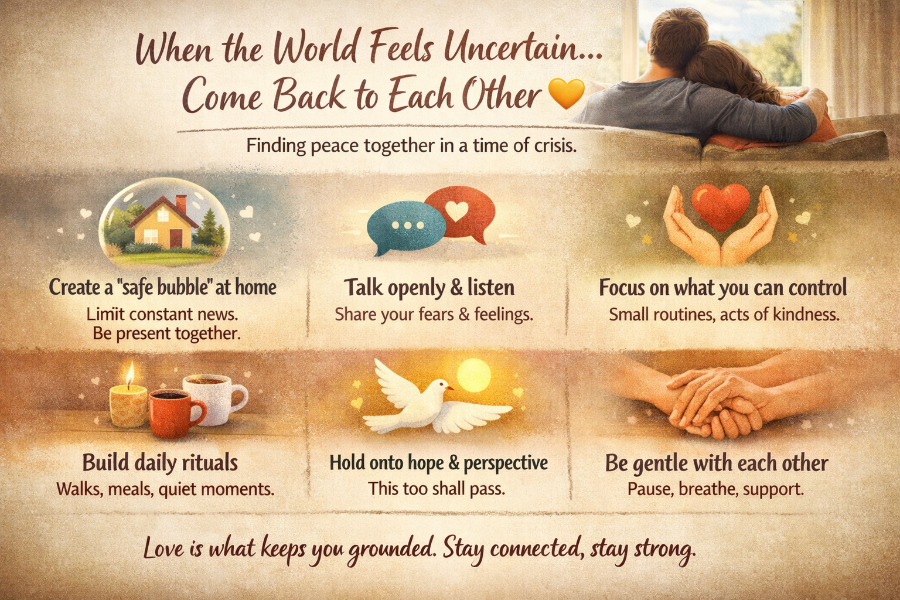
Here are a few gentle ways couples can stay grounded together:
* Create a “safe bubble” at home Limit constant news exposure. Stay informed, but not consumed. Choose specific times to check updates — not all day.
* Talk openly (without trying to fix everything) You don’t need all the answers. Just listening to each other’s fears and thoughts builds emotional safety.
* Focus on what you can control Your routines, your health, your kindness toward each other — these matter more than ever.
* Build small daily rituals A walk, a shared meal, a cup of tea together. These moments anchor you when the outside world feels chaotic.
* Hold onto perspective and hope History shows that even intense conflicts eventually move toward resolution. Right now is not forever.
* Be gentle — with yourself and each other Stress can show up as irritability or withdrawal. Pause, breathe, and remember you’re on the same team.
In uncertain times, love isn’t just a feeling — it’s something you practice.
And sometimes, the most powerful thing you can do… is simply stay connected.
For your convenience, appointments are available as follows:
Recent global tensions involving Iran have been widely reported in the news, and many people are becoming concerned about the potential economic consequences. Rising fuel prices, supply disruptions and the possibility of higher food costs are creating uncertainty for households across Australia.
While these events may seem far away geographically, global conflicts can still affect everyday life — and sometimes they place unexpected strain on relationships.
Why global events can affect relationships
When international conflict disrupts oil supply or shipping routes, it can lead to rising fuel prices and increased costs for transporting goods. Economists warn that disruptions linked to the current conflict could push petrol prices higher and increase the cost of food and everyday items.
For many couples, financial pressure is one of the most significant sources of relationship stress. When household budgets tighten, partners may feel anxious about the future, frustrated with rising expenses, or worried about providing for their family.
Even small financial worries can trigger arguments or misunderstandings if both partners are already feeling overwhelmed.
Stress can show up in unexpected ways
When couples are under stress, the tension often shows up indirectly. One partner may become withdrawn or quiet, while the other may become more critical or reactive. These patterns are common when people feel uncertain about the future.
Concerns about fuel shortages, food costs or the cost of living can create:
More frequent arguments about money
Increased anxiety or irritability
Difficulty communicating calmly
Different views about saving or spending
A sense of emotional distance
Often the real issue isn’t the money itself, but the stress and uncertainty surrounding it.
The cost-of-living pressure many couples are feeling
Australia has already experienced rising living costs in recent years. Global disruptions to energy supplies can add another layer of pressure. Some economists have warned that oil supply disruptions could significantly increase global fuel prices and contribute to inflation.
When couples are already juggling mortgages, rent, groceries and childcare costs, even a small increase in fuel or food prices can make things feel overwhelming.
This can create a cycle where stress leads to conflict, and conflict increases stress even further.
How couples can support each other during uncertain times
During periods of uncertainty, relationships often benefit from slowing down and reconnecting rather than reacting.
A few helpful approaches include:
Talk openly about concerns Instead of bottling up worries about money or the future, sharing concerns calmly can reduce misunderstandings.
Focus on teamwork Remind yourselves that you’re facing challenges together, not against each other.
Avoid blame during stressful moments Financial pressure can easily turn into blame, even when neither partner is responsible for the situation.
Make practical plans together Sometimes simply making a budget or discussing priorities can reduce anxiety.
When outside support can help
If stress is beginning to affect communication or connection in a relationship, speaking with a counsellor can help couples step out of reactive patterns and reconnect.
Relationship counselling provides a neutral space where both partners can feel heard and supported while learning practical tools to improve communication and reduce conflict.
If you and your partner are feeling the strain of financial pressure, uncertainty or ongoing conflict, counselling can help you move from frustration toward understanding and connection.
For your convenience, appointments are available as follows:
If it feels like couples are carrying more tension lately, you’re not imagining it.
In 2026, many relationships are under pressure from constant connectivity, financial uncertainty, AI-driven workplace change, and the mental load of simply “keeping up.” Even strong couples are noticing shorter tempers, less patience, and more misunderstandings.
The good news? Conflict isn’t the problem. Disconnection is.
Let’s explore what’s happening — and what helps.
The New Stressors Affecting Couples
1. Digital Saturation (Even When You’re in the Same Room)
Phones are no longer just devices — they are workplaces, news feeds, entertainment hubs, and social spaces. Couples often sit beside each other physically while being mentally elsewhere.
Micro-disconnections add up:
Half-listening while scrolling
Checking emails during dinner
Watching separate reels in bed
Interrupting connection for notifications
Over time, partners may feel unseen or less important than a screen.
2. Financial Anxiety & Economic Shifts
Across Australia, many couples are navigating:
Rising living costs
Housing stress
Career instability
Changing work models (hybrid, remote, AI-supported roles)
Even if finances are stable, uncertainty alone can increase baseline stress — and stress reduces emotional bandwidth.
When we’re anxious, we become reactive.
3. The Invisible Mental Load
Modern couples are often committed to equality — but many still struggle with the invisible labour of planning, remembering, organising, and emotional caretaking.
Common patterns include:
One partner feeling overwhelmed but not asking for help
The other partner feeling criticised and unsure what’s wrong
Escalation over “small” issues that are actually about feeling unsupported
It’s rarely about the dishwasher. It’s about feeling alone in the responsibility.
The Real Issue: Emotional Safety
Research from relationship science (including the work of Dr John Gottman at The Gottman Institute) consistently shows that stable couples aren’t those who avoid conflict — they are those who repair quickly and maintain emotional safety.
Emotional safety means:
I can express frustration without being attacked.
I can be vulnerable without being dismissed.
We can disagree without threatening the relationship.
Without safety, partners shift into defence mode:
Criticism
Stonewalling
Sarcasm
Withdrawal
These aren’t signs of bad people. They’re signs of nervous systems under strain.
Three Practical Ways to Reconnect This Week
1. The 10-Minute Daily Reset
Set a timer for 10 minutes each evening. Turn phones off. Refrain from problem solving and day-to-day issues.
Each partner answers:
What was one stressor today?
What did I need emotionally?
One thing I appreciated about you.
This builds connection without pressure.
2. Clarify the Mental Load
Instead of arguing about tasks, try this:
List everything required to keep your household and relationship functioning — appointments, bills, emotional check-ins, planning, social events.
Then ask:
Who is holding this mentally?
Is that working for both of us?
Awareness reduces resentment.
3. Slow the Conflict Down
When you notice escalation:
Lower your voice.
Pause for 20 minutes if needed.
Return with curiosity instead of argument.
Try: “I think we’re both overwhelmed. Can we reset?”
Repair attempts matter more than being right.
A Gentle Truth
Every couple I meet wants the same thing: to feel chosen, valued, and safe.
Disconnection often happens gradually. So does reconnection.
If 2026 has brought more tension into your relationship, it doesn’t mean you are failing. It may simply mean you are navigating modern stress without enough support.
With intentional conversation, clearer boundaries around digital life, and space to understand each other’s inner world, couples can move from reactivity back to partnership.
If you’re feeling stuck in repetitive conflict or emotional distance, support can help you shift the pattern — not just manage the arguments.
For your convenience, appointments are available as follows:
In 2025, Australian couples face unique stressors—rising cost of living, work-life imbalance, mental health pressures, housing strain—all converging to put pressure on relationships. National surveys show 79% of Australians have experienced relationship pressures in the past six months.
These influences make couple therapy more vital than ever—to not only preserve relationships, but to foster resilience, transparency, and well-being.
2. Financial Tensions & “Money Secrets”
Money causes conflict for a majority: Around 58% of Australian couples say finances are a major source of discord.
Financial infidelity is highly damaging: Roughly 1 in 5 Australians believe financial deception (e.g., hiding debt, secret spending) is a worse betrayal than romantic infidelity.
Hidden lies about spending and debt are common: Of Australians admitting to financial deception, 33% lied about spending, 25% about debt levels, and 24% about things like coffee or takeaway expenses.
Women under more financial stress: A staggering 53% of Australian women report experiencing financial stress—especially those in partnerships or with children.
Recommended: Transparency and shared planning can restore trust. Tools like dual personal/joint accounts, regular open money check-ins, and joint budgeting are essential. Financial stress shouldn’t be navigated in silence.
3. Mental Health & Relationship Harmony
Relationship conflict impacts mental well-being: Among nearly 7,000 Australian adults, marital harmony (or conflict) accounted for nearly 10% of variance in mental health self-assessments, measured via HILDA data.
Mental health challenges are systemic: In any given year, an estimated 1 in 5 Australians aged 16–85 experience a mental health disorder.
Engaging in therapy may help to normalize mental health struggles, support coping strategies, and encourage partners to cultivate empathy for each other’s lived emotional experiences.
4. Communication & External Pressures
While stats on miscommunication like mishearing are more global, Australians face specific challenges:
Housing stress – especially in metropolitan areas, can strain emotional bandwidth and time together.
Graphical spread and multicultural dynamics add unique pressures to intimacy and understanding.
Therapeutic tools: Encourage scheduled device-free time, emotional check-ins, and culturally sensitive communication work—especially when physical distance or life changes press on the relationship.
5. How These Pressures Intertwine in Sessions
Scenario: Consider “Emily and Josh”—a couple juggling mortgage stress, Emily’s anxiety, and fights over small expenses like takeaways. The tension becomes emotional distance, and long silences at night deepen disconnection.
Counselling path:
Psycho-education: Explore how financial stress and anxiety amplify each other.
Emotional tools: Establish a “feelings check-in” at week’s end and daily tech-free connection rituals.
Mental health work: Normalise anxiety, suggest individual support through counselling and explore mindfulness or stress-reduction as couple activities.
6. To summarise: The Most Pressing Themes for Aussie Couples in 2025
Financial strain & deception: Over half of Aussie couples face money stress; hidden debts or spending betray trust.
Mental health interwoven with relationship quality: Emotional well-being is both affected by—and affects—relationship dynamics.
Communication challenged by time poverty, finances, and living situations: The typical Australian couple may juggle jobs, childcare, work-from-home setups, and the cost-of-living—not leaving much emotional bandwidth.
Key Take-away: Focus on holistic healing—repairing trust through financial clarity, supporting each other’s mental health, and rediscovering emotional connection amidst everyday challenges. It’s in this blend that relational resilience thrives.