Committed to a non-judgemental approach to helping couples, individuals and families enjoy a more fulfilling life, loving relationships and optimal health and wellbeing.
With everything happening globally right now — including the ongoing conflict in Iran — it’s natural to feel unsettled, anxious, or even overwhelmed. (Encyclopedia Britannica)
But in times like these, your relationship can become your greatest source of stability.
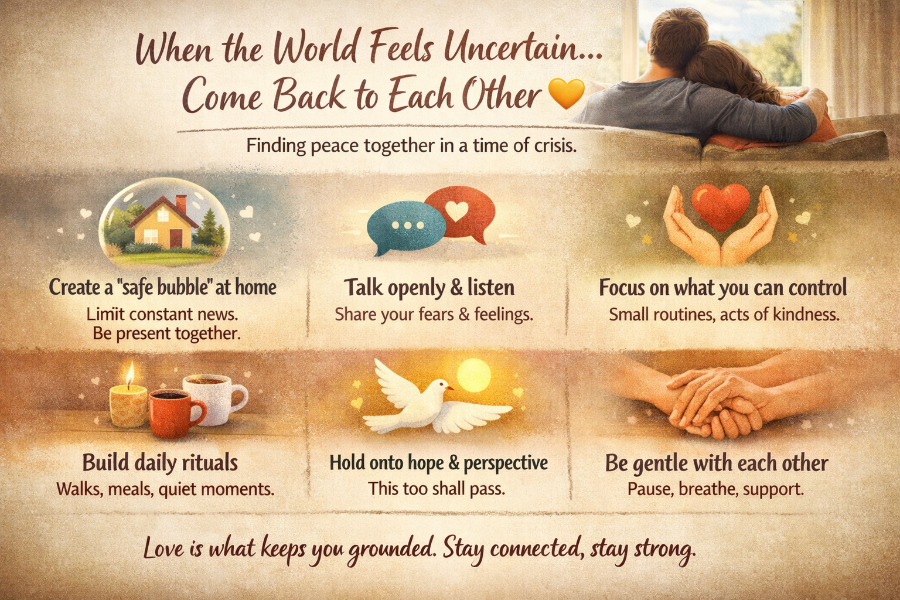
Here are a few gentle ways couples can stay grounded together:
* Create a “safe bubble” at home Limit constant news exposure. Stay informed, but not consumed. Choose specific times to check updates — not all day.
* Talk openly (without trying to fix everything) You don’t need all the answers. Just listening to each other’s fears and thoughts builds emotional safety.
* Focus on what you can control Your routines, your health, your kindness toward each other — these matter more than ever.
* Build small daily rituals A walk, a shared meal, a cup of tea together. These moments anchor you when the outside world feels chaotic.
* Hold onto perspective and hope History shows that even intense conflicts eventually move toward resolution. Right now is not forever.
* Be gentle — with yourself and each other Stress can show up as irritability or withdrawal. Pause, breathe, and remember you’re on the same team.
In uncertain times, love isn’t just a feeling — it’s something you practice.
And sometimes, the most powerful thing you can do… is simply stay connected.
For your convenience, appointments are available as follows:
It’s hard to ignore the tension in the air lately.
Rising living costs. Global conflicts. Constant news updates that seem to shift by the hour. Even if you’re not directly affected, the emotional weight of it all has a way of seeping into everyday life.
And for couples, this pressure often shows up quietly—through short tempers, emotional distance, or that subtle feeling of “we’re not quite on the same page anymore.”
If that sounds familiar, you’re not alone.
Stress Doesn’t Just Stay Personal — It Becomes Relational
When uncertainty increases, our nervous systems go on high alert. Some people become more anxious and seek reassurance. Others withdraw, needing space to cope.
Neither response is wrong—but together, they can create a painful cycle:
One partner reaches out
The other pulls away
Both feel misunderstood
Over time, this can look like communication breakdown… but underneath, it’s usually stress and fear.
The Real Risk: Emotional Disconnection
Many couples assume problems come from “poor communication.”
But more often, the issue is emotional disconnection.
You might still be talking about logistics—bills, kids, schedules—but missing the deeper conversations:
“How are you actually feeling about everything right now?”
“What’s been weighing on you lately?”
“Are you feeling supported by me?”
Without these check-ins, couples can start to feel like housemates rather than partners.
3 Simple Ways to Reconnect (Even When Life Feels Heavy)
You don’t need hours of deep conversation or a perfect relationship to reconnect. Small, consistent shifts make a big difference.
1. Name the Stress — Don’t Personalise It
Instead of:
“You’ve been distant lately.”
Try:
“I feel like stress is getting between us. Do you feel that too?”
This changes the dynamic from me vs you to us vs the problem.
2. Create a 10-Minute Daily Check-In
No phones. No fixing. Just listening.
Ask each other:
What was the hardest part of your day?
What helped you get through it?
This builds emotional safety without pressure.
3. Assume Good Intentions
Under stress, it’s easy to misread each other:
Silence becomes “they don’t care”
Irritability becomes “they’re against me”
Pause and ask:
“Could there be another explanation?”
This one shift can prevent unnecessary conflict.
You’re On the Same Team — Even If It Doesn’t Feel Like It
Stress has a way of making couples forget that they’re allies.
But the truth is, most couples aren’t breaking down because they don’t love each other.
They’re overwhelmed. Tired. Carrying more than they realise.
And often, they just don’t know how to find their way back to each other.
A Final Thought
In uncertain times, your relationship can either become another source of stress… or your greatest place of stability.
The difference isn’t perfection.
It’s willingness:
To pause
To listen
To turn toward each other, even when it’s hard
If things feel off in your relationship right now, it doesn’t mean something is broken.
It might just mean it’s time to reconnect.
For your convenience, appointments are available as follows:
Recent global tensions involving Iran have been widely reported in the news, and many people are becoming concerned about the potential economic consequences. Rising fuel prices, supply disruptions and the possibility of higher food costs are creating uncertainty for households across Australia.
While these events may seem far away geographically, global conflicts can still affect everyday life — and sometimes they place unexpected strain on relationships.
Why global events can affect relationships
When international conflict disrupts oil supply or shipping routes, it can lead to rising fuel prices and increased costs for transporting goods. Economists warn that disruptions linked to the current conflict could push petrol prices higher and increase the cost of food and everyday items.
For many couples, financial pressure is one of the most significant sources of relationship stress. When household budgets tighten, partners may feel anxious about the future, frustrated with rising expenses, or worried about providing for their family.
Even small financial worries can trigger arguments or misunderstandings if both partners are already feeling overwhelmed.
Stress can show up in unexpected ways
When couples are under stress, the tension often shows up indirectly. One partner may become withdrawn or quiet, while the other may become more critical or reactive. These patterns are common when people feel uncertain about the future.
Concerns about fuel shortages, food costs or the cost of living can create:
More frequent arguments about money
Increased anxiety or irritability
Difficulty communicating calmly
Different views about saving or spending
A sense of emotional distance
Often the real issue isn’t the money itself, but the stress and uncertainty surrounding it.
The cost-of-living pressure many couples are feeling
Australia has already experienced rising living costs in recent years. Global disruptions to energy supplies can add another layer of pressure. Some economists have warned that oil supply disruptions could significantly increase global fuel prices and contribute to inflation.
When couples are already juggling mortgages, rent, groceries and childcare costs, even a small increase in fuel or food prices can make things feel overwhelming.
This can create a cycle where stress leads to conflict, and conflict increases stress even further.
How couples can support each other during uncertain times
During periods of uncertainty, relationships often benefit from slowing down and reconnecting rather than reacting.
A few helpful approaches include:
Talk openly about concerns Instead of bottling up worries about money or the future, sharing concerns calmly can reduce misunderstandings.
Focus on teamwork Remind yourselves that you’re facing challenges together, not against each other.
Avoid blame during stressful moments Financial pressure can easily turn into blame, even when neither partner is responsible for the situation.
Make practical plans together Sometimes simply making a budget or discussing priorities can reduce anxiety.
When outside support can help
If stress is beginning to affect communication or connection in a relationship, speaking with a counsellor can help couples step out of reactive patterns and reconnect.
Relationship counselling provides a neutral space where both partners can feel heard and supported while learning practical tools to improve communication and reduce conflict.
If you and your partner are feeling the strain of financial pressure, uncertainty or ongoing conflict, counselling can help you move from frustration toward understanding and connection.
For your convenience, appointments are available as follows:
In 2026, we are more “connected” than ever, yet many couples feel like they’re living on separate islands. Between remote work blurring the lines of home life, the constant hum of notifications, and the “comparison trap” of social media, intimacy often takes a backseat to efficiency.
At Caring4Couples, we’re seeing a shift. The primary challenge for modern partners isn’t just “communication”—it’s presence.
Why “Quality Time” Needs an Upgrade
We used to think quality time meant a weekly dinner date. Today, that’s not enough if you’re both checking emails between courses. True connection now requires Digital Boundaries.
The “Micro-Rejection”: When your partner starts a conversation and you glance at a vibrating phone, it sends a subtle signal: This device is more important than you. Over time, these micro-rejections build a wall of resentment.
The Comparison Hangover: It’s easy to feel your relationship is “failing” when you’re bombarded with curated highlights of other couples’ vacations and milestones.
3 Ways to Reconnect This Week
You don’t need a total lifestyle overhaul to see a difference. Small, intentional pivots can shift the entire energy of your home:
The 10-Minute Tech Blackout: Establish a “phone-free zone” during the first 10 minutes after you both finish work. No scrolling, no checking Slack—just eye contact and a genuine “How are you feeling?”
Shared Boredom: It sounds counterintuitive, but some of the best intimacy happens in the quiet moments. Try a “low-dopamine” evening: a walk, a puzzle, or simply sitting together without a screen as a buffer.
Active Appreciation: In a fast-paced world, we tend to focus on what our partner isn’t doing. Flip the script. Once a day, call out something specific you appreciate, no matter how small.
You Don’t Have to Navigate This Alone
Every relationship hits a plateau where the old tools just don’t work anymore. Whether you’re navigating the complexities of a “dual-career” household, parenting in the digital age, or simply feeling the spark fade, therapy isn’t just for “fixing” things—it’s for optimizing your bond.
“The greatest gift you can give your partner is your undivided attention.”
At Caring4Couples, we provide a safe, modern space to help you rediscover the person sitting right across from you.
For your convenience, appointments are available as follows: